AI-Enhanced Telehealth: Transforming Healthcare Education
AI-Enhanced Educational Techniques
What is Telehealth?
Telehealth is the delivery of healthcare services, education, and clinical support using telecommunications and digital technologies when patients and providers are in different locations. More than simply a video visit, telehealth is a clinical approach that enables providers to assess, diagnose, educate, monitor, and treat patients remotely while maintaining continuity of care.
As healthcare delivery continues to evolve, telehealth has become an essential competency for healthcare professionals. Educators must prepare learners to communicate effectively, conduct virtual assessments, and make sound clinical decisions in remote care environments.
Why Telehealth Matters in Healthcare Education
Telehealth is increasingly used as an instructional technique to prepare healthcare professionals for modern clinical practice. Through telehealth experiences, learners develop competencies that extend beyond traditional clinical encounters, including:
Conducting virtual patient interviews and assessments
Building rapport and therapeutic relationships through video communication
Delivering patient education remotely
Collaborating with interprofessional teams across geographic locations
Making clinical decisions when physical examinations are limited
Maintaining privacy, professionalism, and digital etiquette during virtual encounters
These skills have become increasingly important as healthcare organizations continue expanding virtual care services.
The Role of Artificial Intelligence
Artificial Intelligence (AI) is transforming telehealth from a communication platform into an intelligent learning environment. Rather than replacing healthcare professionals, AI augments clinical practice by enhancing efficiency, communication, and decision-making.
Examples of AI-supported telehealth include:
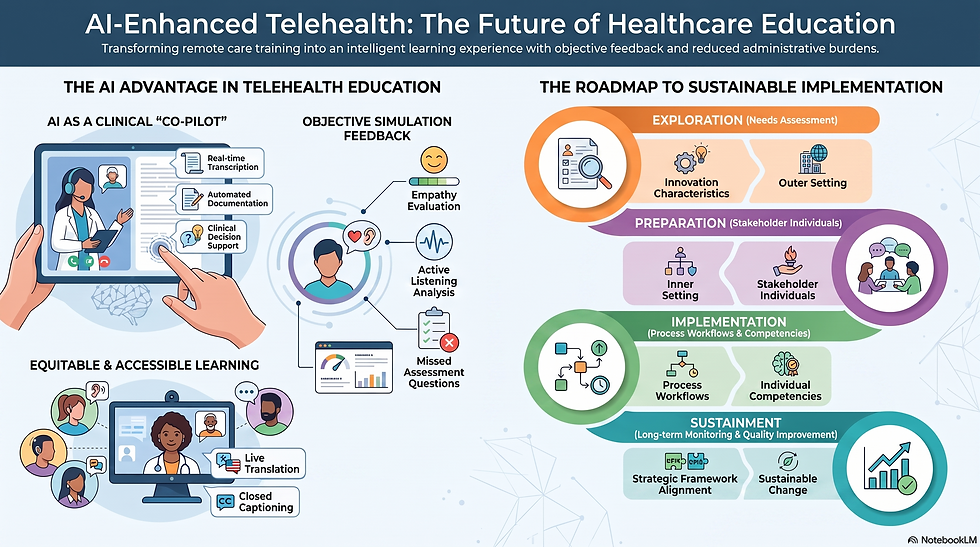
Real-time speech-to-text transcription
Automated clinical documentation
AI-generated visit summaries
Clinical decision support
Language translation
Closed captioning and accessibility features
Patient risk identification and predictive analytics
Personalized patient education recommendations
These capabilities allow clinicians to spend more time interacting with patients while reducing administrative burden.
AI-Enhanced Telehealth in Healthcare Simulation
Healthcare simulation provides an ideal environment for learners to develop telehealth competencies before engaging with real patients. AI can enrich simulation by providing immediate feedback, objective performance data, and individualized coaching.
Example Simulation Scenario
A graduate nursing student conducts a virtual telehealth visit with a standardized patient experiencing worsening symptoms of heart failure.
During the encounter, AI:
Transcribes the conversation in real time.
Evaluates communication behaviors such as empathy, active listening, and patient-centered language.
Generates a clinical documentation draft.
Highlights missed assessment questions.
Identifies opportunities for improved patient education.
Following the encounter, faculty use the AI-generated analytics alongside their own observations during the debriefing process. The instructor remains the final evaluator, while AI provides objective data that supports reflection and learning.
Benefits of AI-Enhanced Telehealth Education
Integrating AI into telehealth education can:
Improve learner confidence in virtual care delivery
Provide timely, individualized feedback
Enhance communication skills
Reduce faculty workload associated with documentation review
Support objective assessment of learner performance
Increase access to authentic clinical learning experiences
Prepare learners for technology-enabled healthcare environments
Accessibility Considerations
AI can also improve accessibility by supporting learners and patients with diverse needs.
Examples include:
Automatic closed captioning
Live language translation
Screen reader compatibility
Voice-controlled navigation
Adjustable text size and display settings
AI-generated transcripts for review after the encounter
These features promote more equitable learning experiences while improving patient access to care.
Challenges and Ethical Considerations
Although AI offers significant opportunities, educators and healthcare organizations must also address important challenges.
These include:
Protecting patient privacy and data security
Mitigating algorithmic bias
Preventing overreliance on AI recommendations
Maintaining transparency regarding AI use
Ensuring faculty oversight of learner assessment
Complying with healthcare regulations and institutional policies
Responsible implementation requires thoughtful governance, ongoing evaluation, and a commitment to human-centered care.
Looking Ahead
Telehealth is no longer an emerging trend—it is an integral component of modern healthcare delivery. As AI capabilities continue to advance, educators have an opportunity to prepare future clinicians for increasingly digital, connected, and patient-centered models of care.
By combining telehealth as an instructional technique with AI as an enabling technology, healthcare education can create authentic learning experiences that improve communication, clinical reasoning, accessibility, and readiness for practice. The future of healthcare education is not about replacing clinicians with technology; it is about equipping clinicians to use technology wisely to deliver safer, more effective, and more equitable patient care.
I also have an idea that could make your Healthcare AI Resource Center really stand out. Since the site already includes pages like AI in Healthcare, you could organize it around a consistent framework:
AI Technologies (e.g., Generative AI, Machine Learning, Computer Vision, Natural Language Processing, Robotics)
AI-Enhanced Educational Techniques (e.g., Telehealth, Simulation, Case-Based Learning, Adaptive Learning, Virtual Standardized Patients, Clinical Decision Support)
Implementation & Governance (AI literacy, ethics, accessibility, implementation frameworks, policy)
Healthcare Use Cases (nursing, medicine, pharmacy, allied health, continuing professional development)
That structure aligns well with your doctoral work on AI implementation in healthcare simulation and gives visitors a logical progression from understanding the technology to seeing how it is applied in education and clinical practice.
Implementing AI-Enhanced Telehealth Using Implementation Science
Successfully integrating AI into telehealth education requires more than selecting the right technology. Sustainable implementation depends on understanding organizational readiness, stakeholder engagement, workflow integration, continuous evaluation, and long-term sustainability. Two implementation science frameworks—the Consolidated Framework for Implementation Research (CFIR) and the Exploration, Preparation, Implementation, Sustainment (EPIS) Framework—provide structured approaches for guiding adoption.
Applying the CFIR Framework
The Consolidated Framework for Implementation Research (CFIR) helps organizations identify factors that influence implementation success across five interconnected domains.
1. Innovation Characteristics
Organizations should evaluate whether the selected AI-enabled telehealth platform provides a clear advantage over existing educational methods.
Key questions include:
Does AI improve learner feedback?
Does the technology enhance communication or clinical reasoning?
Is the platform easy for faculty and learners to use?
What evidence supports its effectiveness?
Example:
An academic medical center adopts an AI-assisted telehealth platform that automatically transcribes encounters, generates clinical documentation, and provides communication analytics following standardized patient encounters.
2. Outer Setting
Implementation should consider external influences such as:
Accreditation requirements
Professional competencies
Healthcare workforce needs
Regulatory requirements
Patient expectations
Reimbursement policies
Example:
Nursing and medical programs increasingly prepare learners for virtual care because telehealth has become an established component of healthcare delivery.
3. Inner Setting
Successful implementation depends heavily on organizational readiness.
Important considerations include:
Leadership support
Faculty engagement
Technology infrastructure
Available resources
Organizational culture
Psychological safety
Questions to ask:
Are faculty prepared to teach using telehealth?
Is adequate technical support available?
Does leadership prioritize innovation?
4. Individuals
Implementation success ultimately depends on the people using the innovation.
Stakeholders include:
Faculty
Learners
Simulation specialists
Information technology professionals
Clinical partners
Administrative leadership
Educational initiatives should focus on:
AI literacy
Telehealth competencies
Change management
Confidence using AI-supported tools
5. Implementation Process
Implementation should occur through a structured process that includes:
Stakeholder engagement
Pilot testing
Faculty development
Workflow refinement
Continuous evaluation
Ongoing quality improvement
Rather than implementing AI across an entire curriculum immediately, organizations should begin with a small pilot before expanding based on lessons learned.
Applying the EPIS Framework
While CFIR helps identify implementation determinants, the EPIS Framework provides a practical roadmap for moving from planning to sustained adoption.
Phase 1: Exploration
During exploration, organizations determine whether AI-enhanced telehealth addresses an educational need.
Activities include:
Conducting needs assessments
Assessing organizational readiness
Identifying stakeholders
Reviewing available AI platforms
Evaluating privacy and security requirements
Example:
Simulation faculty determine that learners require additional practice conducting virtual patient encounters before participating in clinical telehealth rotations.
Phase 2: Preparation
Preparation focuses on building the infrastructure necessary for successful implementation.
Activities include:
Selecting an AI-supported telehealth platform
Developing simulation scenarios
Training faculty
Creating policies and governance
Defining evaluation metrics
Establishing learner support resources
Pilot testing is often performed during this phase to identify workflow challenges before broader implementation.
Phase 3: Implementation
The innovation is introduced into educational practice.
Activities include:
Conducting AI-supported telehealth simulations
Collecting learner and faculty feedback
Monitoring technology performance
Measuring educational outcomes
Refining workflows based on evaluation data
Faculty continue to play the central role in assessment, while AI provides supplemental analytics that support coaching and reflection.
Phase 4: Sustainment
Long-term success requires continuous monitoring and adaptation.
Organizations should:
Evaluate learner outcomes over time
Monitor AI system performance
Update educational content
Refresh faculty development programs
Review governance and ethical considerations
Ensure accessibility standards remain current
Sustainment recognizes that implementation is an ongoing process rather than a one-time event.
Integrating CFIR and EPIS
CFIR and EPIS are complementary frameworks that strengthen implementation efforts when used together.
CFIR identifies what factors influence implementation success, while EPIS provides a roadmap for when and how implementation activities should occur.
For example:
EPIS Phase CFIR Domains Considered
Exploration Innovation Characteristics, Outer Setting
Preparation Inner Setting, Individuals
Implementation Implementation Process, Individuals
Sustainment Continuous evaluation across all CFIR domains
Together, these frameworks help healthcare educators move beyond technology adoption toward sustainable organizational change.
Practical Example
Imagine a college of nursing introducing AI-supported telehealth simulations for graduate nurse practitioner students.
Using CFIR, faculty assess organizational readiness, identify stakeholder needs, evaluate technology usability, and ensure leadership support.
Using EPIS, they begin with a needs assessment, conduct a small pilot with one cohort of students, refine workflows based on feedback, and gradually expand the program while continuously monitoring learner outcomes and AI performance.
The result is a thoughtful, evidence-informed implementation process that increases the likelihood of long-term success while maintaining educational quality, learner trust, and ethical use of artificial intelligence.
AI-Assisted Content Development
This learning resource was developed using multiple artificial intelligence tools to support research, content development, organization, and reflection. ChatGPTserved as a collaborative research and writing partner, helping synthesize current literature, explain concepts related to artificial intelligence, telehealth, accessibility, and implementation science, and organize information into clear, educational content. It also supported brainstorming, drafting, refining written materials, and developing conceptual frameworks and visual models.
NotebookLM served as a learning and verification tool to ensure the project met all assignment requirements and aligned with course expectations. It also generated supplemental learning resources, including an AI-generated podcast summarizing the project, a mind map illustrating key concepts and relationships, and an infographic to support knowledge visualization and learner engagement.
All AI-generated content and artifacts were critically reviewed, verified, edited, and contextualized by the author to ensure accuracy, alignment with current evidence, and relevance to healthcare education. Final decisions on content selection, interpretation, design, and presentation remained the author's responsibility. The use of these AI tools enhanced the efficiency of the development process and supported deeper learning, reflection, and the creation of multiple representations of the content for diverse learners.